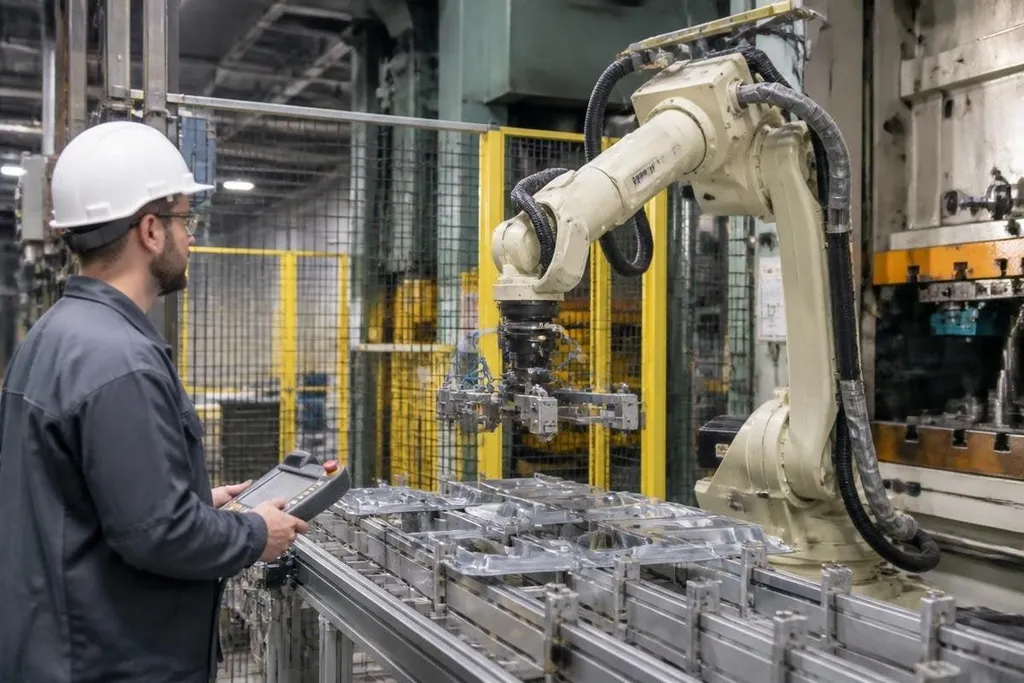
A factory robot earns its place through completed work: a set cycle time, a known payload, and fewer stops during a shift. The future of factory automation will depend on those results, not on how human the machine looks.
- Robot value will rest on repeatable work, safe handoffs, and clear costs.
- Flexible systems may help plants handle more product changes.
- Buyers still need proof from live production, not a staged demonstration.
More robots will work beside existing equipment
Many factories already have conveyors, presses, welding cells, inspection cameras, and software that cannot be replaced in one purchase. New robots will need to connect to that equipment through ordinary signals, data links, and safety systems.
That makes the arm only one part of the installation. A robot that picks a part well can still slow the line if its gripper needs manual resets or its controller cannot exchange status with the factory system.
The useful question is narrow: which task should the robot complete, and what must happen before the next task starts? A clear answer gives buyers a way to check cycle time, payload, reach, error recovery, and changeover time.
Flexibility will matter when products change
Factory work often changes when a new part replaces an old one, a package gets a different shape, or production moves between product sizes. A fixed robot cell can handle a narrow job well, while a system with cameras, adjustable tooling, and software settings may handle more variation.
That flexibility has a cost. Workers need to set up the robot, check its motions, and fix errors when the camera sees a part in the wrong position. A short changeover matters only when the plant changes jobs often enough to recover the added cost.
Software will shape this choice. Robot programming may become easier for technicians who know the process but don't write code. Still, easier setup does not remove the need to test every motion near people, tools, and moving material.
Safety and maintenance stay in the room
A factory robot shares space with people through fences, scanners, light curtains, safe speed limits, and emergency stops. The layout decides how quickly a worker can reach a control or clear a fault, so safety belongs in the first design review.
Maintenance will also decide if a system works on a real shift. Buyers should ask which parts wear out, how faults appear on the control screen, and how long a trained technician needs to return the cell to service.
A repair log matters more when it names the robot, factory, fault, date, and time back in service. Factory robotics reporting from Robot24.com can tie those details to the work the machine completed, giving buyers a better test than a short launch demo.
The proof factories still need
No evidence pack was supplied for this forecast, so firm claims about prices, rollout dates, factory counts, or named systems would be guesswork.
The next stage of factory robotics needs records from working sites that show the full task, including stops and human intervention.
A buyer can ask for this evidence before signing a purchase order:
- Live task video: Does the recording show a full work cycle without cuts?
- Cycle record: What time does the robot take per part, including pauses?
- Error log: How often does a person clear a failed pick or bad placement?
- Changeover test: How long does a technician need to switch products?
- Service plan: Which parts are stocked, and who repairs the cell?
- Cost sheet: Does the price include tooling, software, training, safety gear, and setup?
These checks turn a broad forecast into a plant decision. They also show where a robot may help and where a simpler machine, fixture, or process change may be the better choice.
What to watch next
The next useful factory robot will finish a defined job across a full shift, report its failures, and fit the plant's existing controls. I'd skip any purchase based only on a short demonstration; ask for the cycle record and error log first.
The open question is how much product change a robot can handle before the setup work costs more than the task saves. The answer will come from production records, not from a smoother demo.